
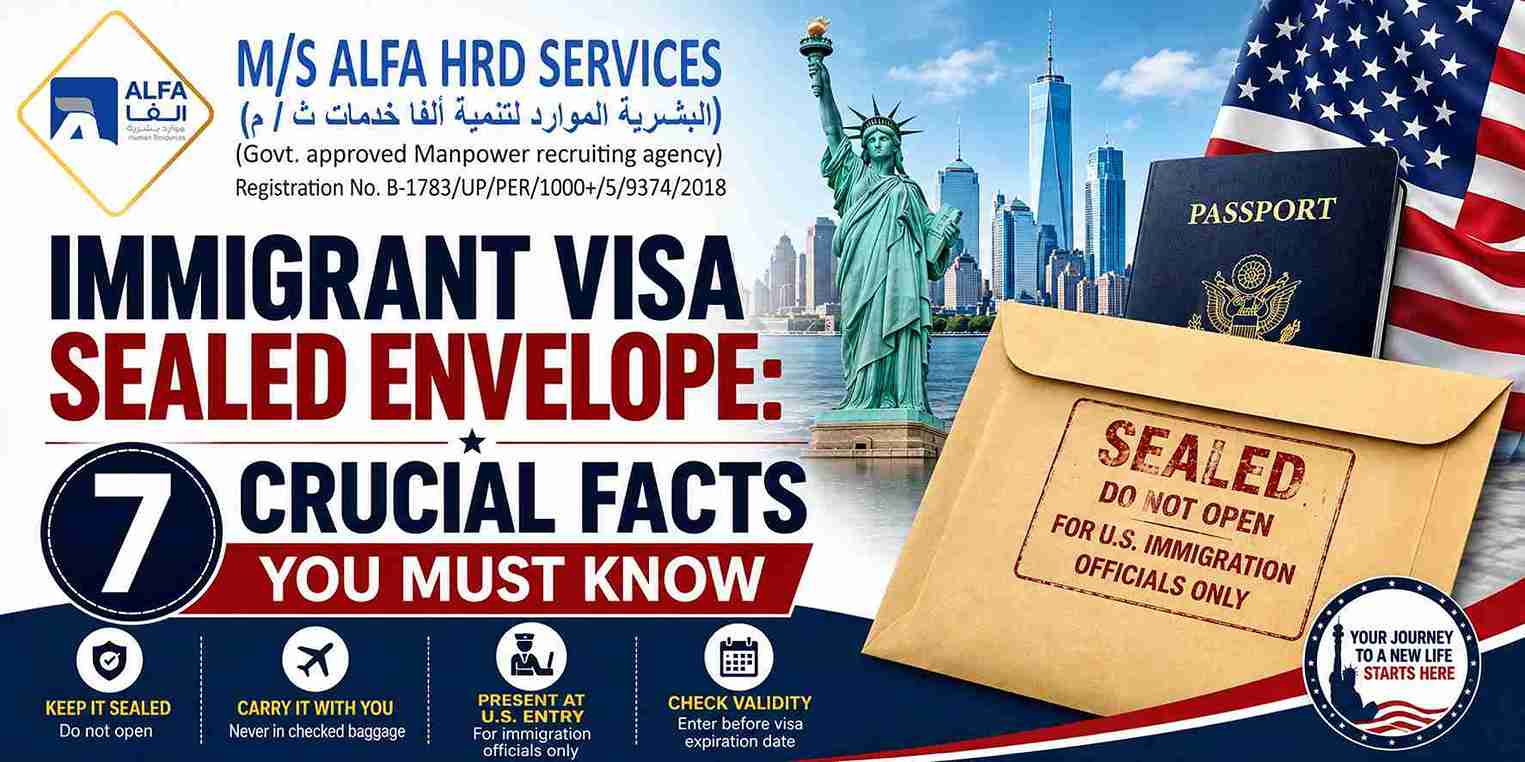
If you’ve recently received a U.S. immigrant visa, you may have noticed something that looks simple but is extremely important: a sealed immigrant visa envelope. For many applicants, receiving this envelope means the long visa journey is finally nearing its final stage. However, it also creates an important question: What is inside the immigrant visa sealed envelope, and what should you do with it?
The U.S. Department of State explains that certain immigrant visa applicants receive a sealed packet containing documents that must be presented to U.S. immigration authorities when they first arrive in the United States. Applicants who receive one should not open it and should carry it with them rather than placing it in checked baggage.
This guide explains the purpose of the sealed envelope, how to handle it before travel, what happens at the U.S. port of entry, common mistakes to avoid, and what you should do if you have concerns about your packet.
Important: The procedures of immigration services in India can vary by visa category, embassy or consulate, and case circumstances. Always follow the instructions issued with your visa and check official U.S. government sources for the latest requirements.
Comprehensive Article Outline
| Section | Topic Covered |
| 1 | What an Immigrant Visa Sealed Envelope Is |
| 2 | Why the Envelope Must Remain Sealed |
| 3 | What You Should Do After Receiving It |
| 4 | How to Travel With the Sealed Packet |
| 5 | What Happens at the U.S. Port of Entry |
| 6 | Common Mistakes to Avoid |
| 7 | Special Situations and Modern Electronic Processing |
| 8 | Frequently Asked Questions |
| 9 | Conclusion |
1. What Is an Immigrant Visa Sealed Envelope?
An immigrant visa sealed envelope is a packet that may be provided to an immigrant visa applicant after the visa has been approved and issued. It contains documents intended for U.S. immigration authorities when the immigrant arrives in the United States.
The packet is not simply another copy of the documents you submitted during your visa process. Instead, it is part of the immigration processing procedure and is intended for examination by the appropriate U.S. immigration official.
According to the U.S. Department of State, an immigrant visa holder may receive a passport containing the immigrant visa along with a sealed packet. The packet should remain sealed and should be presented to U.S. immigration authorities when the traveler arrives in the United States.
What Is the Purpose of the Sealed Packet?
The basic purpose is to provide immigration officials with the relevant documentation associated with your immigrant visa case.
Think of it as an official handoff package between the visa-issuing authority and the U.S. immigration officer at the port of entry.
The process generally looks like this:
- You complete the immigrant visa application process.
- You attend the required interview.
- Your immigrant visa is approved and issued, if you are found eligible.
- Your passport is returned with the immigrant visa.
- Depending on your case, you may receive a sealed immigrant packet.
- You keep the packet sealed during travel.
- You present it to U.S. immigration authorities when instructed upon arrival.
- The immigration officer reviews the required information and determines your admission.
The Department of State specifically states that only the U.S. immigration official should open the sealed packet.
Read Related – International Job Seeker Visa: Complete Guide
Is Every Immigrant Visa Applicant Given a Sealed Envelope?
No. This is an important point.
Modern immigrant visa processing increasingly uses electronic document transmission. In some cases, an applicant may not receive a physical sealed packet because the necessary documents have been transmitted electronically to U.S. authorities.
For example, some U.S. embassy instructions explain that an annotation such as “IV Docs in CCD” can indicate that documents have been transmitted electronically and that a physical immigrant packet may not be provided.
Therefore, don’t panic if another immigrant visa applicant receives an envelope and you don’t. The correct procedure depends on your case and the instructions provided with your visa.
What Does the Envelope Look Like?
The appearance can vary by embassy, consulate, and processing method. It may be a sealed envelope or packet containing immigration-related documentation.
The most important characteristic isn’t its color, size, or design. It’s the fact that it has been officially sealed and is intended for U.S. immigration authorities.
If you receive one, treat it as an official immigration document.
2. Why Must You Not Open the Immigrant Visa Sealed Envelope?
This is probably the most important rule in this entire process.
Do not open the immigrant visa sealed envelope.
The U.S. Department of State clearly instructs immigrant visa holders not to open the sealed packet because it is intended to be opened by U.S. immigration officials upon arrival.
Why Is the Envelope Sealed?
The seal helps preserve the integrity of the documents inside the packet.
When immigration authorities receive the packet, they need to know that it has remained closed since it was prepared by the issuing authority. Opening it yourself can interfere with that process.
In simple terms, the sealed packet is not meant for you to inspect.
You don’t need to know every document inside it. Your responsibility is to keep it secure and deliver it as instructed.
What Happens If You Accidentally Open It?
If you accidentally damage or open the packet, don’t simply ignore the situation.
The safest approach is to contact the embassy or consulate that issued your immigrant visa and explain exactly what happened. Keep the packet and all contents secure, and follow the instructions you receive.
Don’t attempt to reseal the packet yourself and assume that everything will be fine.
Immigration cases can be different, so the issuing authority is the best source for instructions about a damaged or opened packet.
Can You Open It to Check Your Documents?
No.
You may be curious about whether your birth certificate, police certificate, affidavit of support documents, or other records are inside. However, curiosity isn’t a reason to break the seal.
Instead, keep copies of your personal documents separately.
Before traveling, you should have your own organized travel folder containing documents you may legitimately need during your journey, such as:
- Passport
- Immigrant visa
- Travel itinerary
- Copies of important civil documents
- Relevant medical documentation
- Vaccination records where appropriate
- Contact details for your U.S. petitioner or employer
- U.S. address and contact information
- Proof of required payments where applicable
The sealed packet should remain separate and untouched.
What About the Medical Examination Envelope?
Don’t confuse the immigrant visa packet with the medical examination envelope.
In some locations, a panel physician may provide medical examination results in a sealed envelope. The U.S. Embassy or Consulate may instruct applicants to bring that sealed envelope to the visa interview without opening it. The U.S. Embassy in New Delhi, for example, provides instructions concerning sealed medical examination results.
So, you could encounter more than one sealed envelope during the immigration process.
Always follow the instructions given by the relevant U.S. embassy, consulate, or panel physician.
3. What Should You Do After Receiving the Sealed Envelope?
Once you’ve received the immigrant visa and sealed packet, the next stage is preparation for travel.
This is where a little organization can save you a lot of stress.
Step 1: Check Your Passport and Visa
First, carefully review the immigrant visa printed in your passport.
Check important details such as:
- Full name
- Date of birth
- Visa category
- Passport information
- Visa expiration date
- Other important biographical information
If you notice an apparent error, contact the issuing embassy or consulate promptly rather than waiting until you’re at the airport.
The Department of State advises applicants to review their immigrant visa for errors after receiving it.
Step 2: Check the Visa Expiration Date
Don’t assume you can travel whenever you want.
Your immigrant visa has an expiration date, and you must generally enter the United States before that date. The Department of State specifically states that an immigrant visa holder must enter the United States before the expiration date printed on the visa.
The validity period can vary based on your case and medical examination validity.
So, before booking your final travel arrangements, look carefully at the visa.
Step 3: Keep the Envelope Secure
Place the sealed packet in a secure location.
Avoid folding, crushing, tearing, stapling, punching holes in, or otherwise altering the envelope.
A good practice is to keep it in a protective document folder that allows you to carry it safely without putting pressure on the seal.
Step 4: Keep It in Your Carry-On
This is another major rule.
Do not put your sealed immigrant visa packet in checked luggage.
The U.S. Department of State instructs immigrant visa holders to carry the packet with them rather than putting it into checked baggage.
That’s practical advice, too. Checked baggage can be delayed, lost, or damaged.
Your immigration documents should stay with you throughout your journey.
Step 5: Pay the USCIS Immigrant Fee When Required
Many people assume that getting the immigrant visa means every immigration-related step is complete.
Not necessarily.
The Department of State states that individuals issued immigrant visas overseas generally must pay the USCIS Immigrant Fee before traveling to the United States, subject to applicable exemptions. USCIS uses this process to handle immigrant visa processing and production of the Permanent Resident Card.
Keep your payment information and confirmation available with your travel records.
Step 6: Organize Your Supporting Documents
Even though the sealed packet contains documents for immigration authorities, you should still carry your own important records.
For example, if you’re moving to the United States for employment, it may be helpful to have copies of:
- Employment offer or employment information
- U.S. employer contact details
- Professional qualifications
- Educational records
- Relevant licenses
- Financial records
- U.S. residential address
- Family contact information
Don’t place your personal copies inside the sealed government packet.
Read Related – How Can I Get Job in Dubai? A Complete Guide for Indian Job Seekers
4. How Should You Travel With the Immigrant Visa Sealed Envelope?
Traveling with immigration documents can feel stressful, especially if you’re immigrating for the first time.
The key is simple: keep the packet secure, accessible, and unopened.
Carry It in Your Hand Luggage
The packet should remain with you during the flight.
Your carry-on bag is generally a better location than checked baggage because you’ll retain physical control over it throughout the journey.
You should also avoid handing it to other travelers.
Don’t Put It in Your Suitcase
A checked suitcase can be delayed or lost. If your immigration documents are inside that suitcase, you may face unnecessary complications upon arrival.
The U.S. Department of State explicitly says not to put the sealed immigrant packet in checked luggage.
Keep Your Passport With You
Your immigrant visa is printed in your passport, so your passport is equally important.
Keep your passport and sealed packet together in a secure travel folder.
However, don’t tape or permanently attach the packet to your passport.
What About Airport Security?
Airport security personnel may inspect your luggage as part of normal security procedures. If necessary, explain that you are carrying an official sealed immigration packet and follow the instructions of airport personnel.
Don’t open it simply because you’re worried someone may ask what’s inside.
What If the Envelope Gets Wet?
If the envelope is accidentally exposed to water, don’t open it to inspect the contents.
Protect it from further damage and contact the issuing embassy or consulate for instructions if the seal or documents appear compromised.
What If the Envelope Is Torn?
A torn or damaged seal should be treated seriously.
Don’t attempt a DIY repair with glue or tape unless the issuing authority specifically tells you to do so.
Contact the relevant U.S. embassy or consulate and explain the condition of the packet.
5. What Happens at the U.S. Port of Entry?
Arriving in the United States is an exciting moment, but your immigration process isn’t necessarily over the instant your aircraft lands.
You still need to be inspected by U.S. immigration authorities.
At the airport or other port of entry, you will present your passport, immigrant visa, and other documents as instructed.
Who Opens the Sealed Packet?
If you were issued a physical sealed immigrant packet, the U.S. immigration official is responsible for handling it.
The Department of State states that the sealed packet should not be opened by the traveler and is intended for the U.S. immigration official.
What Does the Immigration Officer Do?
The officer may review your immigration documentation, confirm your identity, ask questions, and conduct the required inspection before deciding whether to admit you.
Approval of the visa allows you to travel to a U.S. port of entry and request admission. A visa itself does not guarantee admission; the final admission decision is made by the appropriate U.S. immigration authorities.
Principal Applicant and Family Members
Families should pay particular attention to the order of travel.
The Department of State states that, for immigrant visas, the principal applicant must enter the United States before or at the same time as family members holding dependent immigrant visas.
Therefore, don’t casually plan separate family travel without checking the rules that apply to your specific case.
What About X-Rays?
If you received X-rays as part of your medical examination, you may need to carry them with you when traveling to the United States.
The U.S. Embassy in New Delhi specifically instructs immigrant visa holders who receive X-rays to carry them with them and provide them to U.S. immigration authorities when required.
Follow the specific instructions given by your panel physician and embassy.
6. Seven Common Mistakes to Avoid
A smooth immigration journey isn’t only about having the correct visa. It’s also about avoiding preventable mistakes.
Mistake 1: Opening the Envelope
This is the biggest mistake.
If the packet is sealed and intended for U.S. immigration authorities, leave it sealed.
Mistake 2: Putting It in Checked Baggage
Don’t do this.
Carry it with you throughout your journey.
Mistake 3: Ignoring the Visa Expiration Date
Your visa isn’t open-ended.
Check the expiration date and plan your travel accordingly.
Mistake 4: Failing to Check Visa Details
A spelling mistake or incorrect personal detail should be raised promptly with the issuing authority.
Mistake 5: Forgetting the USCIS Immigrant Fee
Eligible immigrant visa holders generally need to pay the USCIS Immigrant Fee before traveling to the United States.
Mistake 6: Packing Important Documents Away
Your passport, visa, sealed packet, and other essential immigration documents should remain accessible.
Mistake 7: Assuming Every Applicant Gets the Same Packet
Immigration processing is increasingly electronic. Some applicants may not receive a physical sealed packet because documents have been transmitted electronically.
For example, certain embassy instructions explain that applicants with an “IV Docs in CCD” annotation may not receive a physical packet.
Read Related – How to Apply for Airport Jobs: A Guide for Freshers & Experienced Candidates
7. Modern Electronic Processing: What If You Don’t Receive an Envelope?
This is one of the most useful updates for today’s immigrant visa applicants.
Historically, sealed physical packets were a familiar part of the immigrant visa process. However, electronic processing has changed how some cases are handled.
Some U.S. posts now use electronic transmission of immigrant visa documents. As a result, an applicant may receive an immigrant visa without a physical sealed packet.
The absence of an envelope doesn’t automatically mean something is wrong.
Look for Instructions or Visa Annotations
Read all paperwork and instructions that came with your passport.
If your visa contains an annotation indicating electronic document transmission, follow the relevant instructions.
Some U.S. government guidance explains that when required documents are available electronically, an applicant may not need to carry a physical sealed packet.
Don’t Compare Your Case Too Closely With Someone Else’s
Your friend, relative, or colleague may have received a sealed packet while you didn’t.
That doesn’t necessarily indicate a problem.
Visa processing depends on:
- Visa category
- Consular post
- Case circumstances
- Document-processing method
- Electronic transmission procedures
- Applicable government instructions
When in doubt, rely on your own official instructions rather than social media posts or informal advice.
8. Immigrant Visa Sealed Envelope vs. Medical Envelope
These two envelopes can easily cause confusion.
| Feature | Immigrant Visa Packet | Medical Examination Envelope |
| Issued by | Embassy/consulate or related visa process | Panel physician |
| Main purpose | Documents for U.S. immigration authorities | Medical examination documentation |
| Should the applicant open it? | No | Generally no when instructed to remain sealed |
| Where used | At U.S. entry, when applicable | During visa processing or as specifically instructed |
| Can procedures vary? | Yes | Yes |
| Best source of instructions | U.S. embassy/consulate | Panel physician/embassy |
For example, the U.S. Embassy in New Delhi explains that some medical examination results may be provided in a sealed envelope and that applicants should not open it.
This distinction matters because opening the wrong envelope can create unnecessary complications.
9. Official Resources for Immigrant Visa Applicants
Because U.S. immigration rules and procedures can change, it’s smart to use official sources rather than relying solely on blogs or social media.
Useful resources include:
- U.S. Department of State – Immigrant Visas
- U.S. Department of State – Employment-Based Immigrant Visas
- U.S. Embassy New Delhi – Immigrant Visa Instructions
- USCIS – Immigrant Fee Information
If you’re applying from India, always check the instructions applicable to the U.S. embassy or consulate handling your case.
10. Frequently Asked Questions About the Immigrant Visa Sealed Envelope
1. What is an immigrant visa sealed envelope?
It is a sealed packet that may be provided to an immigrant visa holder and contains documents intended for U.S. immigration authorities. The traveler must keep it sealed and present it as instructed upon arrival.
2. Can I open my immigrant visa sealed envelope?
No. If you receive a sealed immigrant packet, you should not open it. The U.S. Department of State states that the packet is intended to be opened by U.S. immigration officials.
3. Should I put the sealed envelope in checked baggage?
No. Carry it with you rather than placing it in checked luggage.
4. What if I accidentally opened the envelope?
Contact the U.S. embassy or consulate that issued your visa and explain what happened. Don’t try to conceal the issue or simply reseal the packet yourself.
5. Does everyone receive a sealed immigrant packet?
No. Some cases use electronic document transmission, meaning an applicant may not receive a physical packet. Follow the instructions associated with your visa.
6. Can I check the documents inside before traveling?
You shouldn’t open the sealed packet. Instead, keep separate personal copies of the documents you may need for your own records.
7. Do I need to pay the USCIS Immigrant Fee?
Many people who receive immigrant visas overseas must pay the USCIS Immigrant Fee before traveling, although specific exemptions apply. The Department of State recommends completing this step before travel.
8. What happens to the packet when I arrive in the United States?
If you received a physical sealed packet, you present it to U.S. immigration authorities as instructed. The immigration official handles the packet during the inspection process.
9. What if my sealed packet is damaged?
Don’t open it or attempt an unauthorized repair. Contact the issuing embassy or consulate for case-specific instructions.
10. Can I travel after receiving my immigrant visa?
You must enter the United States before the expiration date printed on your immigrant visa. Check your visa carefully and make travel arrangements accordingly.
11. Final Checklist Before Your Flight
Before leaving for the United States, take a few minutes to review your immigration travel documents.
- Passport with immigrant visa
- Sealed immigrant packet, if one was issued
- USCIS Immigrant Fee completed, if applicable
- Visa expiration date checked
- Visa details checked for errors
- Required medical documents available
- X-rays carried separately when instructed
- U.S. destination address available
- Petitioner or employer contact information available
- Personal copies of important documents prepared
- Sealed packet placed in carry-on baggage
- Sealed packet remains unopened
Conclusion
Receiving an immigrant visa sealed envelope can be an exciting milestone because it often means you’re approaching the final stage of your move to the United States. However, the packet should be treated as an official immigration document, not as something you need to inspect yourself.
The most important rule is simple: if you receive a sealed immigrant visa packet, don’t open it. Keep it secure, carry it with you rather than putting it in checked luggage, and present it to U.S. immigration authorities when required.
At the same time, remember that not every immigrant visa applicant receives a physical packet. Modern electronic processing means that some cases are handled digitally. Therefore, always follow the instructions specifically provided for your visa and case.
A little preparation goes a long way. Check your visa details, confirm the expiration date, complete applicable USCIS fee requirements, organize your personal documents, and keep all essential immigration paperwork accessible during your journey.

